Since our team marked the first UK & Ireland Aortic Dissection Awareness Day in 2015, we have continued to develop what the day stands for and how we use it. Raising awareness remains at its core, but each year we look for new ways to amplify the message, reach people who have never heard of aortic dissection and use that increased visibility to support improvements in patient care.
In 2026, we pushed that message further again. Aortic dissection reached national UK media, our content was shared widely across social media and the charity’s Awareness Day webpage saw its biggest spike in visitors to date. Patients, families, clinicians and supporters helped take information well beyond our own channels, introducing the condition to people who may never previously have encountered it.
But really, our community made September what it was. Aortic Dissection Awareness Day has grown because people affected by aortic dissection continue to speak about it, fundraise, share information, tell their stories and encourage others to get involved.
Taking Awareness into Local Communities
With Aortic Dissection Awareness Day falling on a Saturday this year, there was an obvious opportunity to take the message somewhere that brings communities together every weekend, parkrun.
From Sussex to Scotland, Dover to Dudley, Bristol to Banstead and many more places in between, members of Team Aorta joined parkruns across the country. Some ran or walked, while others volunteered and supported from the sidelines.
At many of the events, aortic dissection was mentioned during the pre-run briefing, giving organisers the chance to explain what the condition is and why awareness matters. We hear regularly from patients and families that they had never heard of aortic dissection until it happened to them or somebody they loved, so introducing the condition to thousands of people in familiar community settings can make a real difference.
The impact often starts with something very simple. A charity t-shirt prompts a question, a conversation follows, and another person goes home knowing what aortic dissection is. We are enormously grateful to everyone who represented Team Aorta and to the parkrun communities that helped us share the message.

Investing in Specialist Aortic Care
The evening of the awareness day itself ended with an announcement that showed exactly what we mean when we talk about turning awareness into action.
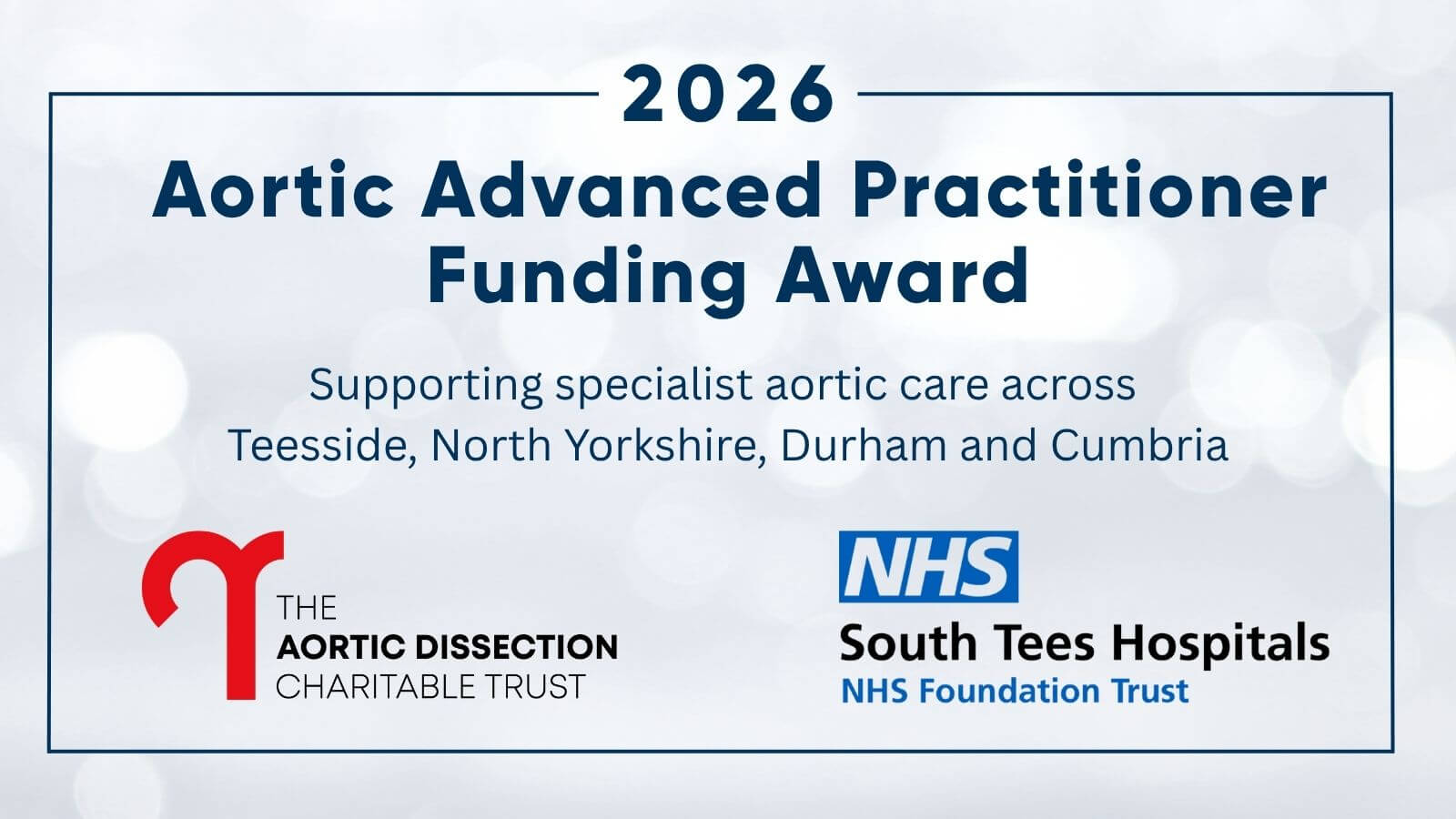
During our evening webinar, the charity announced that South Tees Hospitals NHS Foundation Trust had secured our funding for a dedicated TADCT Aortic Advanced Practitioner.
Based at James Cook University Hospital, the new role will help strengthen lifelong care for people with thoracic aortic disease across Teesside, North Yorkshire, Durham and Cumbria. The Advanced Practitioner will support long-term follow-up and surveillance while providing specialist guidance for patients and families throughout what can be a complex and lifelong journey.
The South Tees team has already been developing its aortic service in response to a growing volume and complexity of cases. This funding will allow that work to become more sustainable and give the service dedicated capacity to coordinate care for patients across a large geographical area.
It was also an opportunity to recognise the people who make this programme possible. Our incredible community of individual fundraisers and corporate donors has enabled the charity to invest directly in specialist patient care. Every challenge completed, donation made and fundraising event organised contributes to work that can have a lasting impact on patients and families.
Putting Lived Experience at the Heart of Education
September was particularly busy for the charity’s education team and patient advocates, with representation at BioMedEng26, the UK Aortic Society Annual Meeting, the Global Aorta Symposium, the Interdisciplinary Aortic Dissection Symposium and AORTIC LIVE.
These meetings bring together many of the professionals shaping the future of aortic medicine, from surgeons and cardiologists to researchers, engineers and specialist nurses. For the charity, they also provide an important opportunity to ensure that the lived experience of aortic dissection is part of those conversations.
Many of this year’s events included dedicated lived experience sessions delivered by the charity and our patient advocates. These sessions help connect discussions about surgery, research, pathways and new technology with what those developments actually mean for patients and families.
Aortic dissection does not end when somebody leaves the operating theatre or goes home from hospital. Patients can face long-term surveillance, medication, uncertainty, changes to everyday life and the emotional impact of surviving a sudden life-threatening event. Hearing directly from people who have experienced that journey helps ground professional discussion in the outcomes that matter to them.
We are extremely grateful to every patient advocate who shared their experience during September and to the organisers who made space for those contributions. Bringing medical expertise and lived experience together remains an important part of how the charity supports education and better care.
Keeping Aortic Dissection on the Political Agenda
The weeks around the awareness day also saw aortic dissection raised in the Scottish Parliament.
At First Minister’s Questions on 15th September, Adam Harley MSP asked the Scottish Government to consider national guidance covering the prevention, diagnosis, treatment and aftercare of aortic dissection. His question also recognised the late Lord Jim Wallace, who had campaigned alongside the Aortic Dissection Charitable Trust for better aortic dissection care in Scotland.
First Minister John Swinney said the Scottish Government would give active consideration to the proposal and asked Cabinet Secretary for Health and Care Angela Constance to engage further with Adam Harley and the charity. He also recognised the importance of clear pathways and access to them wherever patients live in Scotland.
For the charity, this was a timely example of why awareness must be about more than visibility. Raising the profile of aortic dissection creates opportunities to have wider conversations about what patients need and how care can be strengthened. The Aortic Dissection Charitable Trust will continue to advocate for clear and consistent national guidance that supports patients and families across Scotland.
Challenging Demographic Blind Spots
September also brought a new episode of the Aortic Dissection Podcast, continuing a series that brings patients and medical experts together to explore the issues that matter to our community.
The latest episode focused on demographic blind spots in aortic dissection, looking at the assumptions that can develop around age, sex and ethnicity and why those assumptions matter.
Patients and experts shared their perspectives on who is affected by aortic dissection, representation within research and the importance of recognising that the condition does not fit one particular patient profile. The conversation also covered blood pressure, recovery, cardiac rehabilitation and the support patients and families may need after leaving hospital.
The podcast has become another way for the charity to make specialist information accessible while giving lived experience an equal place in the conversation. It allows people to hear directly from others who have been through aortic dissection, alongside professionals who can help explain the clinical questions that often arise during recovery and long-term care.

Charity-Funded Research Reaches Publication
Research supported by the charity also reached an important milestone during the month, with work exploring the use of artificial intelligence in diagnosing acute aortic syndrome published in the BMJ Emergency Medicine Journal.
The AORTA-AI study evaluated 4,776 prediction models and highlighted one of the central challenges facing artificial intelligence when it is applied to uncommon but potentially catastrophic conditions.
Acute aortic syndrome presents a difficult problem for prediction models because relatively few patients arriving in an emergency setting will have the condition, yet missing those who do can have devastating consequences. Models that increase sensitivity may identify more genuine cases but also generate large numbers of false positives, while models that appear statistically successful may still miss patients who need urgent investigation.
One of the striking findings was that a model which simply assumed nobody had acute aortic syndrome could appear to perform well according to some conventional measures. It is a useful reminder that apparent accuracy does not necessarily translate into safe or useful clinical decision-making.
This is an important challenge for the next generation of AI-supported emergency medicine and exactly the type of question that needs careful research. New technology has enormous potential, but it must be evaluated against the realities of the conditions clinicians are trying to diagnose and the consequences for the patients behind the data.
Team Aorta Takes on the Great North Run
The month had already started with another strong showing from Team Aorta at the Great North Run, where our runners joined thousands of people taking on one of the UK’s best-known half marathons.
As always, the reasons for running were personal. Some were remembering loved ones, while others were supporting family members, celebrating survival or simply choosing to use their challenge to help improve the future for people affected by aortic dissection.
Every Team Aorta shirt out on the course helped raise the profile of the condition, while the money raised contributes directly to the wider work of the charity. That includes patient support, professional education, research and investment in projects such as our nurse programme.
We are hugely grateful to everyone who ran, donated, shared fundraising pages and supported the team along the route.
Awareness That Leads to Action
September 2026 showed what can happen when a community comes together behind those goals, but our ambition goes further. We want greater awareness to support faster diagnosis, better pathways, stronger long-term care, meaningful research and better support for patients and families. Awareness matters most when it leads to action, and our work to drive that change continues year-round.