The Aortic Dissection Charitable Trust contributed to Next Steps for Sláintecare Reform, a national policy forum examining how Ireland can continue moving towards more accessible, integrated and person-centred healthcare.
Trustee Catherine Fowler joined healthcare leaders, HSE representatives, clinicians and patient advocates to bring a lived-experience perspective to discussions about capacity, workforce pressures, community care, patient safety and the future delivery of Sláintecare.
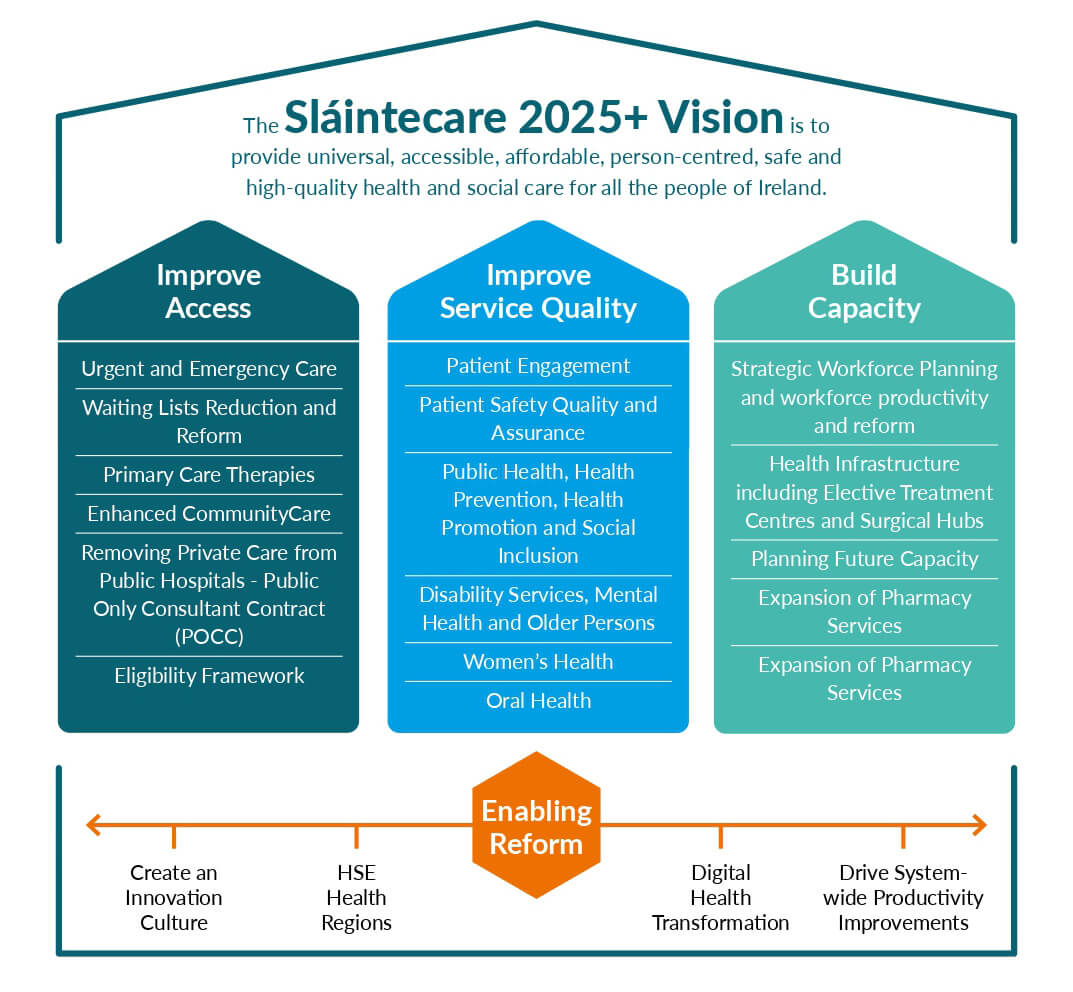
The current Sláintecare 2025+ programme sets out priorities around improving access, improving service quality and increasing health and social care capacity. It also continues to emphasise integrated community care, workforce development and digital transformation.
For the charity, being part of these discussions matters because patients and families ultimately experience healthcare reform. Policies, pathways and structures only achieve their purpose when people can access the right care at the right time and understand what happens next.
Patient Advocacy
Catherine’s connection with healthcare in Ireland is deeply personal. Her father, Tim Fleming, died in 2015 following a missed diagnosis of aortic dissection in Dublin. The inquest returned a finding of medical misadventure, after which the hospital invited Catherine to work alongside its clinical teams to improve systems and processes.
That collaboration led to a new hospital policy for diagnosing and treating aortic dissection. The work subsequently became the basis for national guidance in Ireland and something that has continued to shape the work of the Aortic Dissection Charitable Trust. Patients and families should not only be asked to describe what went wrong. Their experience can help design what happens next.
Catherine explained that meaningful change was possible because patients, families and medical professionals worked together. Rather than treating lived experience as an addition to clinical expertise, it became part of the improvement process itself.
Patient Involvement
A central theme of Catherine’s contribution was that patient and public involvement should be more than box-ticking.
She drew on her experience working as a public patient voice within NHS England, including work supporting the development of a Patient and Public Voice Maturity Matrix. The model provides a way to assess how well patient involvement is embedded and how it develops over time.
Catherine invited those leading Sláintecare reform to consider a similar approach in Ireland. The aim would be to set clear expectations for patient involvement and provide a way to measure whether patients are genuinely influencing decisions at local and national levels.
The HSE already has patient involvement taking place across projects and national policy development. Catherine’s message was therefore about building on that foundation and making meaningful involvement consistent.
Every serious incident, near miss or patient safety failure has a person and family behind it. Their experience can reveal issues that may not be obvious from performance data alone, particularly around communication, escalation, handovers and what happens when concerns are not acted upon. Harnessed constructively, that experience can become a powerful source of learning.
Learning from Harm to Improve the System
Catherine also discussed the value of looking across incidents and claims to understand repeated patterns in healthcare. Individual cases are important, but looking at them collectively can reveal wider themes. These may include communication failures, problems with escalation, missed clinical signs, delays in treatment and difficulties with teamwork.
She suggested that thematic analysis could help support Sláintecare’s broader reform ambitions by identifying where system-wide improvements are needed. Catherine drew on experience from England, where reviews of high-value clinical negligence claims have identified recurring patient safety themes.
This approach is particularly relevant for aortic dissection. Diagnosis often depends on different parts of the system working together quickly. Recognition, escalation, imaging and access to specialist treatment all matter, and delays at any stage can have serious consequences. Learning from what has happened to previous patients can therefore help improve the pathway for those who come afterwards.
Capacity, Workforce and the Reality of Reform
Catherine’s contribution formed part of a wider discussion about whether healthcare services have the capacity and workforce needed to deliver reform.
Steve Pitman, Head of Education at the Irish Nurses and Midwives Organisation, focused on staffing pressures and the need for sustainable workforce planning. His presentation highlighted the importance of safe staffing, investment in nursing and ensuring that a move towards community-based care is supported by enough professionals to deliver it.
This is an important point for any healthcare reform. Moving services closer to home can offer significant benefits for patients, but community care cannot simply absorb additional responsibility without the workforce and resources to support it.
John Fitzmaurice, HSE Integrated Healthcare Area Manager for Sligo, Leitrim, South Donegal and West Cavan, brought an operational perspective to the discussion. He spoke about maximising community capacity, avoiding unnecessary hospital admissions and developing a broader approach to supporting people at home. He said health services cannot achieve this in isolation, and that voluntary organisations, communities and other parts of government also play an important role. No single profession or organisation owns the whole pathway.
Pat Healy, National Director for Services and Schemes at the HSE, discussed developing services closer to home and the need to learn from successful local models. His presentation focused on moving from isolated examples of good practice towards a system where effective approaches are standardised and available more consistently.
A patient should not receive a completely different standard of information, follow-up or support because of where they happen to live. The same applies to recognition in emergency care, access to appropriate imaging and referral into specialist services.
The conference also heard from Niamh Griffin, Health Correspondent at the Irish Examiner, who reflected on Sláintecare from the patient perspective.
Her presentation highlighted progress in areas such as community care and digital services, while also pointing to the continuing significance of waiting times and access. From a patient’s perspective, reform can feel distant if they are still waiting months for an appointment or struggling to reach the right service.
A pathway can exist on paper and still be difficult to navigate. A service can be available but still be inaccessible to the patient who does not know how to reach it. For rare and time-critical conditions, those gaps can have serious consequences.
Reforming Healthcare with Patients
One of the strongest themes across the conference was that structures alone will not deliver better healthcare.
Workforce, resources, accountability and local capacity all matter. So does learning from areas where good care is already being delivered and making that experience more widely available. The closing discussion reflected this, with speakers emphasising equitable access, early intervention, stronger community services and better coordination around the individual.
For the Aortic Dissection Charitable Trust, another essential part of that picture is involving patients and families in shaping the change.
Lived experience brings a perspective that data alone cannot replicate. Combined with clinical expertise and a willingness to learn, it can expose gaps, challenge assumptions, and help create services that work better for the people who depend on them.
That has been the story behind much of our work in Ireland, and it is why we will continue bringing the patient perspective into national conversations about healthcare.
As Catherine told the forum, reforming healthcare in partnership with patients can create better systems for both the people working within them and those they serve.